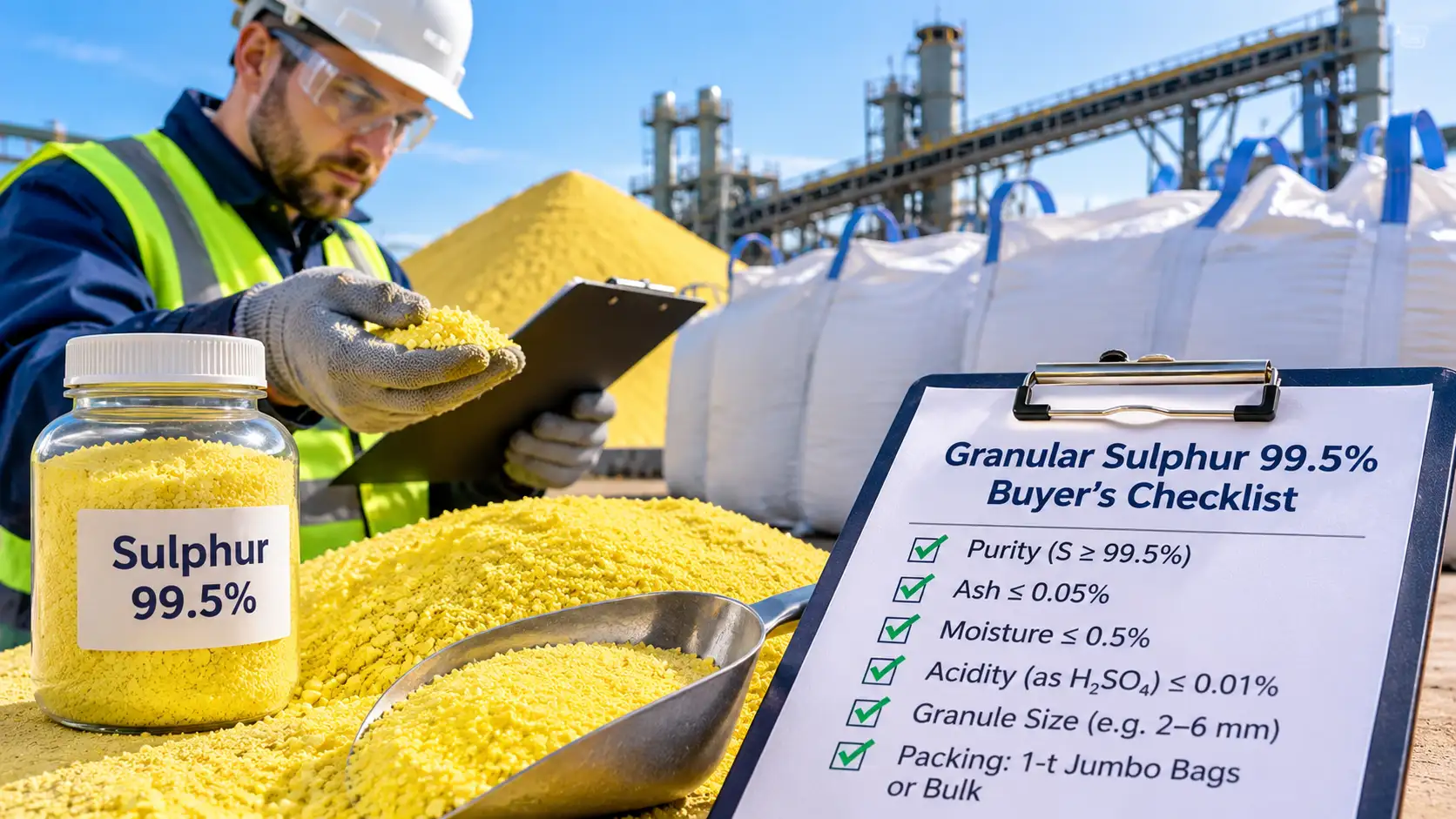
1. The short answer
Before buying granular sulphur, do not rely on the headline figure of 99.5% purity alone. A proper purchase specification should also define ash, moisture, acidity, particle-size distribution, packing condition and the inspection procedure.
The Certificate of Analysis (COA) should show the actual test results for the relevant batch and identify the test methods used. The buyer should compare those results with the limits written into the sales contract—not simply accept a general product description or an old sample certificate.
The figures below are indicative commercial reference values. They are not a substitute for a supplier’s current COA or a mutually agreed contractual specification.
2. Typical specification table
Typical reference values; final limits must be confirmed by the batch COA and contract.
| Parameter | Typical value | What to check |
|---|---|---|
| Sulphur content (S) | ≥ 99.5% | Confirm whether reported on a dry basis |
| Ash | ≤ 0.05% | Check the agreed test method |
| Moisture | ≤ 0.5% | Confirm the result and sampling conditions |
| Acidity (as H₂SO₄) | ≤ 0.01% | Confirm the reporting basis and method |
| Granule size | Specify a range, e.g. 2–6 mm | Define the required percentage within the range |
| Fines and oversized particles | Contract-specific | Set acceptable limits where important |
| Appearance | Yellow granules | Check for contamination and excessive dust |
These are reference values commonly found in commercial descriptions of granular sulphur. Actual specifications differ between suppliers and grades. In particular, a buyer should not assume that every product described as 99.5% sulphur automatically meets the same acidity or particle-size limits.
Bulk Sulphur Trading — BRONCI Barcelona+3
3. Why each parameter matters
Sulphur purity: This indicates the proportion of elemental sulphur in the material. It is a key purchasing parameter for sulphuric acid plants and fertilizer manufacturers. Confirm whether the percentage is calculated on a dry basis, because moisture can affect how results are interpreted.
Ash: Ash represents inorganic residue remaining after the sample is tested. Excessive ash can introduce unwanted material into downstream processes. Buyers should set a limit appropriate to their process and verify it through the agreed test method.
Moisture: Water adds weight without adding sulphur content. High moisture can also affect storage, flow and handling. For buyers paying by metric tonne, the moisture limit should be explicit.
Acidity: Usually reported as sulphuric acid (H₂SO₄) equivalent, this parameter indicates acidic impurities. It should have a clearly stated limit and test method, especially where process or equipment requirements are strict.
Granule size: Particle size affects conveying, feeding, storage and dust generation. A broad description such as “granular” is not enough. Specify the required size range and the percentage of material that must fall within it.
4. How to read a sulphur COA
A COA is useful only when it can be linked to the material being purchased.
Check these points before accepting it:
- Product identification: Does it clearly identify granular elemental sulphur and the relevant grade?
- Batch or lot number: Can the certificate be traced to the shipment or production batch?
- Test date: Is the analysis recent enough to represent the material being offered?
- Actual results: Does it report measured values rather than simply repeating maximum or minimum limits?
- Units and basis: Are percentages expressed consistently? Is sulphur reported on a dry basis?
- Test methods: Are the methods identified for purity, ash, moisture, acidity and particle size?
- Laboratory and approval: Is the issuing laboratory identified, and is the document authenticated by the responsible party?
A specification sheet describes what a supplier offers. A COA reports the test results for a particular batch. These documents serve different purposes and should not be treated as interchangeable.
5. Sampling and inspection at loading
A laboratory result is only as representative as the sample tested. A single handful taken from the surface of a stockpile may not represent an entire cargo. Particle size and fines can vary across a pile or during handling.
For significant shipments, buyers should agree on an inspection procedure before loading. It should define:
- The inspection company or qualified sampling party.
- The quantity and frequency of increments.
- Where and when samples are collected.
- How increments are combined and reduced into laboratory samples.
- Which tests are performed and by which methods.
- How sealed reference samples are identified, stored and retained.
- How discrepancies between the supplier’s and buyer’s results will be handled.
Sampling from a moving product stream during loading can help obtain a more representative sample than relying on a single surface sample. The inspection report should record the sampling procedure and the lot or shipment to which the results apply.
Nuroil Knowledge Centre+1
6. Packing: 1-tonne jumbo bags or bulk?
1-tonne jumbo bags: These are suitable for buyers who need individual handling units, containerised shipments or controlled warehouse distribution. Confirm the bag’s rated capacity, condition, lifting arrangements, liner requirements, labelling and protection against moisture during storage and transit.
Bulk shipment: Bulk loading may be appropriate for large industrial consumers with suitable port facilities, storage and unloading equipment. Buyers should agree on loading and discharge arrangements, cargo protection, inspection points and quantity determination before signing.
The right option depends on shipment volume, destination infrastructure, storage conditions and the buyer’s handling system. Packing should be stated in the contract, not left to assumption.
7. Buyer’s final checklist
Before signing the purchase contract, confirm that you have:
- A complete product specification with agreed limits and units.
- A defined particle-size range and fines requirement.
- A recent COA or an agreed procedure for issuing the batch COA.
- Identified test methods and laboratory details.
- A written sampling and inspection procedure.
- Confirmed packing type and bag capacity, or bulk-loading arrangements.
- Agreed shipment quantity, delivery terms and inspection responsibilities.
- Defined how quality discrepancies and retained samples will be handled.
Frequently asked questions
Is 99.5% sulphur purity enough to approve a shipment?
No. Purity is only one parameter. Moisture, ash, acidity, particle size and the agreed inspection results should also meet the contract.
What is the difference between a specification sheet and a COA?
A specification sheet states the required or offered limits. A COA reports the measured results for a particular batch.
Should granule size be included in the contract?
Yes. State the required size range and the minimum percentage within that range. Add limits for fines and oversized particles if they affect your equipment or process.
Are jumbo bags or bulk shipments better?
Neither is universally better. Jumbo bags offer individual handling units, while bulk shipments can suit large consumers with suitable receiving facilities.
Can a supplier’s sample COA guarantee the next shipment?
No. A sample COA is a reference document, not proof of the quality of a future batch. Request the COA for the actual shipment and agree on inspection before loading.
Need to check a granular sulphur offer before purchasing? Share your required grade, annual volume, packing preference and destination. Ask for the COA and a sample, then send your enquiry to Madar International Pioneering Investment.