Facts as of 4 November 2026. Sources are listed at the end.
Sulfuric acid is the most widely produced chemical in the world. It goes into fertilizers, metals, batteries, paper, pigments, water treatment, dyes and textiles. Most buyers never think about where it comes from. In 2026, many had to.
The link to Hormuz
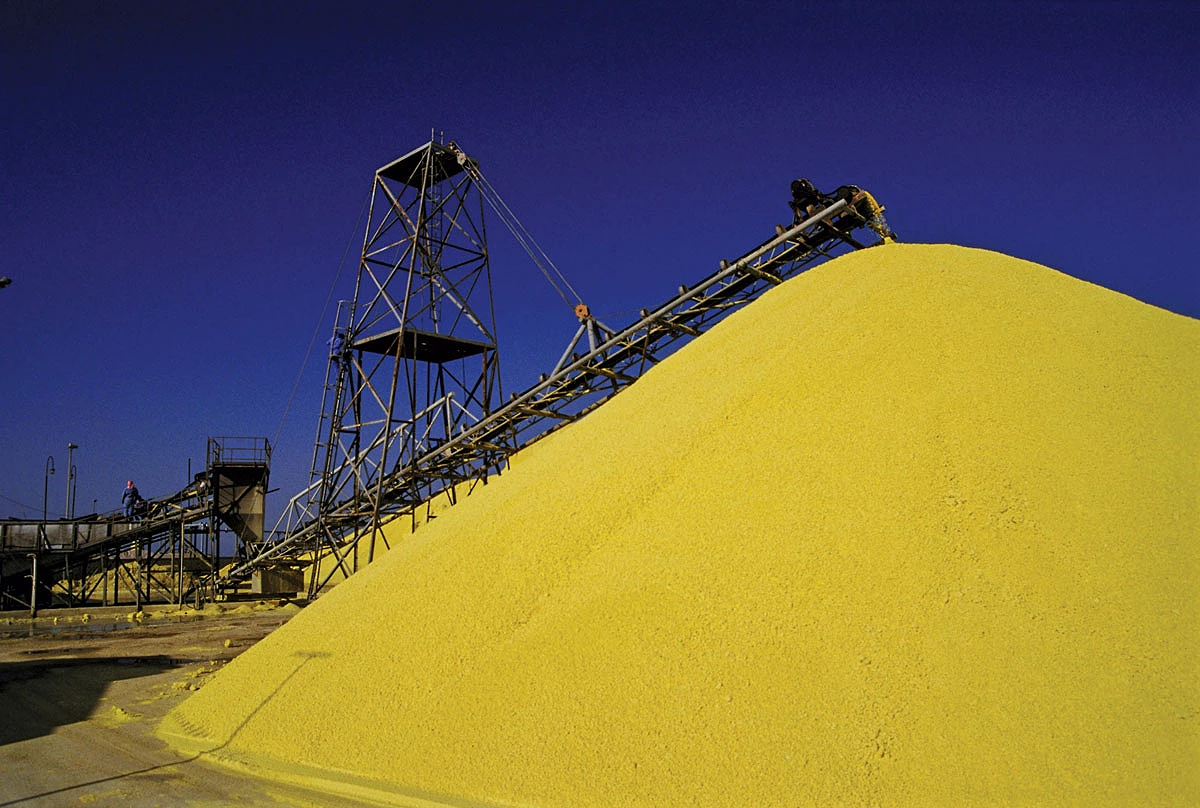
Much of the world's sulfuric acid is made by burning sulfur, and sulfur is a by-product of refining oil and processing gas. The Gulf is one of its largest sources: about half of the world's seaborne sulfur trade normally passes through the Strait of Hormuz, according to the International Energy Agency.
Oil has ways around the strait, such as Saudi Arabia's pipeline to the Red Sea. Sulfur has none. It moves as dry bulk from ports inside the strait, on the few ships willing to make the voyage.
Three shocks at once
- Shipping. In June 2026, Gulf sulfur shipments fell to 147,000 tonnes, against a range of 730,000 to 1.2 million tonnes for June over the previous 11 years (IFPRI).
- Production. Cuts to oil and gas output also cut the sulfur made from them. CRU estimated losses of around 2.3 million tonnes in the Middle East by early July.
- Export restrictions. China, which makes more than 40% of the world's sulfuric acid, reportedly suspended exports for May to December. CRU expects its exports to fall from 4.64 million tonnes in 2025 to 950,000 tonnes this year. Russia has restricted both sulfur and sulfuric acid exports until the end of 2026.
The result
World exports of elemental sulfur fell by a third in the first half of 2026, from 13.5 million to 9 million tonnes, with Gulf suppliers accounting for almost three-quarters of the fall (IFPRI). Argus estimates 2026 exports at 14.5 million tonnes, 30% below 2025.
Tight, not gone
Sulfuric acid has not disappeared. Almost a third of it comes from metal smelters that recover it from copper, zinc and lead ores, without using traded sulfur. Some supply is also returning: Kazakhstan lifted its sulfur export ban on 4 August, China sent acid to Chile again in September, and bulk carriers with Gulf sulfur crossed the strait in October. But availability is uneven, and it depends heavily on where you buy.
In the next article we look at what this has done to prices and who is feeling it. MADAR works in industrial chemicals; for a specific requirement, send us an enquiry and we will confirm availability and price in writing. We know it might be hard to find a product in times of Ware, But, rest assured our sources can get you anything, anytime, anywhere.
Sources
- C&EN, "The war in Iran is disrupting the supply of sulfuric acid, the world's most common chemical", 14 May 2026 (citing the International Energy Agency)
- The Oregon Group, "Global sulphur exports fall 33% in six months as Iran war strands Gulf cargoes", 22 October 2026 (citing IFPRI, CRU and Kpler)
- Akin, "When Supply Chains Break: Force Majeure, Hardship and the Sulfuric Acid Crisis", 2026 (China's share of output)
- ChemNet, report on Middle East sulfur quotations citing Argus, 16 October 2026
- Mining Weekly / Reuters, "Sulphuric acid prices due to extend decline in 2027, CRU says", 20 October 2026